An Editorial Guide to Puri's Timeless Ratha Yatra
By The Voyage Journal Editorial Team · 7-Minute Read
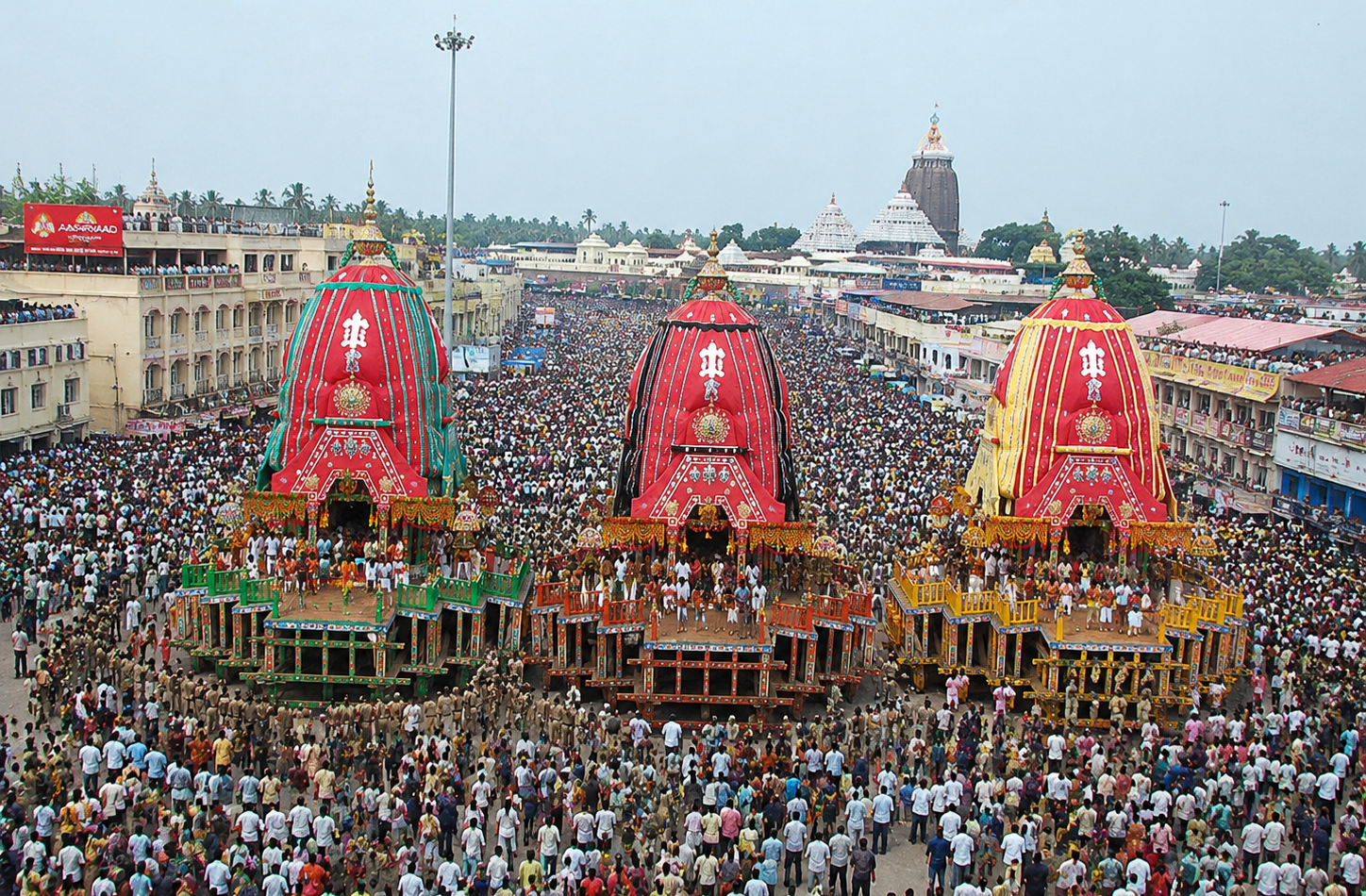
MILLIONS GATHER ALONG PURI'S GRAND ROAD, THE BADA DANDA, AS THE CHARIOTS BEGIN THEIR JOURNEY.
"Once every year, the Divine steps out of the temple — not to be worshipped from afar, but to walk among the people."
v ery summer, as the first light of dawn breaks over the ancient shore of Puri, the city undergoes a transformation few places on earth can rival. The chant of "Jai Jagannath!" rises above the rooftops, conch shells sound across the coastline, and along the storied stretch of the Grand Road, the Bada Danda, a sea of humanity gathers — drawn by something far older than spectacle. Three towering wooden chariots, raised anew each year by the hands of hereditary craftsmen, stand ready to carry their divine passengers into the streets. This is Ratha Yatra: India's most celebrated chariot festival, and one of the most extraordinary expressions of devotion the world has ever staged.
For centuries, pilgrims, historians, photographers, and the simply curious have made their way to Odisha for this one week when the sacred steps outside the sanctum. Ratha Yatra is not so much witnessed as entered into — for here, the Lord leaves the temple to meet humanity in the open street, on entirely equal terms.
|
AT A GLANCE |
|
|
WHERE |
Puri, Odisha — India's eastern coast |
|
WHEN |
June or July, by the Hindu lunar calendar; dates shift each year |
|
DURATION |
A twelve-day cycle, with the chariot pull and the return journey (Bahuda Yatra) as its two great set-pieces |
|
GETTING THERE |
Biju Patnaik International Airport, Bhubaneswar (~60 km); Puri Junction railway station |
|
SIGNATURE MOMENTS |
Pahandi · Chhera Pahanra · the chariot pull · Bahuda Yatra · Suna Besha · Mahaprasad |
|
BEST FOR |
Culture, devotion, photography, and travellers drawn to journeys measured in centuries rather than itineraries |
A TRADITION THAT HAS ENDURED FOR CENTURIES
THE JAGANNATH TEMPLE, PURI — SPIRITUAL HEART OF THE FESTIVAL.
The story of Ratha Yatra is inseparable from the history of this sacred city. Rooted in ancient scriptures such as the Skanda Purana and Brahma Purana, the festival has been celebrated for over a thousand years. At its heart lies a journey both simple and profound: Lord Jagannath, accompanied by Lord Balabhadra and Goddess Subhadra, travels from the Jagannath Temple to the Gundicha Temple, believed to be His aunt's home.
What makes this procession extraordinary is not merely its age but its message. For one week, the Lord leaves the sanctum, making Himself accessible to everyone — irrespective of caste, religion, nationality, or social standing. It is a celebration of inclusivity that continues to move millions across generations, and a rare instance in which the sacred and the everyday share the same stretch of road.
Today, traditions of craftsmanship, ritual, music, and community considered worthy of UNESCO recognition remain remarkably intact. Each year, the three colossal chariots are built anew by hereditary artisans, using techniques handed down, unbroken, through centuries.
"Every wheel, every carved beam, and every rope carries forward a tradition that has survived kingdoms, colonial rule, and the passage of time.”
THE LEGEND BEHIND THE JOURNEY
According to tradition, the festival's origins are as tender as they are timeless. Devi Subhadra, sister to Lord Jagannath and Lord Balabhadra, once expressed a wish to see the city beyond the temple walls — to visit the Gundicha Temple, said to be her aunt's home. Her brothers obliged, placing her between them upon a chariot and travelling with her through the streets of Puri.
What began, in legend, as a sibling's small act of love has been re-enacted every year since, for well over a thousand years — a private gesture turned into public devotion, and an entire city gathered each summer to witness it.
MORE THAN A FESTIVAL — A LIVING EXPERIENCE
THE THREE CHARIOTS ARE REBUILT FROM FRESH TIMBER EACH YEAR BY HUNDREDS OF HEREDITARY ARTISANS.
Long before the procession begins, Puri awakens with anticipation. Streets are dressed in vibrant colour, temples resound with devotional music, and local markets overflow with handcrafted souvenirs, fragrant flowers, and traditional sweets.
The emotional crescendo arrives during Pahandi, when the deities are ceremoniously carried from the sanctum to their chariots amid rhythmic chanting and unrestrained celebration.
PAHANDI: THE DEITIES ARE CEREMONIOUSLY CARRIED FROM THE SANCTUM TO THEIR WAITING CHARIOTS.
Soon after, one of the festival's most moving rituals unfolds: Chhera Pahanra, in which the Gajapati Maharaja, the King of Puri, sweeps the chariots with a golden broom. After the sweeping ritual, and the subsequent fixing of the wooden horses and ropes, the actual pulling of the chariots commences.
CHHERA PAHANRA: THE GAJAPATI MAHARAJA OF PURI SWEEPS THE CHARIOT DECK WITH A GOLDEN BROOM.
This centuries-old ceremony reminds every visitor of a timeless truth: before the Divine, every individual is equal.
As thousands grasp the thick ceremonial ropes and begin pulling the towering chariots along the Bada Danda, the atmosphere becomes almost indescribable. It is not simply a procession; it is a collective act of devotion shared by millions, and one of the rare moments where an entire city moves as a single body.
ARTISANS FIT THE GREAT WOODEN WHEELS BY HAND — A SKILL PASSED DOWN THROUGH GENERATIONS OF HEREDITARY CRAFTSMEN.
|
IN NUMBERS — The three chariots are constructed entirely from fresh wood every year. — More than 1,200 hereditary artisans contribute to the construction process. — The three chariots are named Nandighosha — Lord Jagannath's, dressed in red and yellow, the tallest at approximately 45 feet (13.7 metres); Taladhwaja — Lord Balabhadra's, dressed in red and blue, standing approximately 44 feet high; and Darpadalana — Goddess Subhadra's, dressed in red and black, standing approximately 43 feet high. — Before the ropes are taken up, servitors carry the Angya Mala — a ceremonial “garland of permission” — to the chariot ground; only after it arrives is the pull allowed to begin. — On the fifth day, Hera Panchami sees Goddess Lakshmi visit the Gundicha Temple to see Lord Jagannath and, in a symbolic expression of loving anger at being left behind, her attendants damage a small part of His chariot, Nandighosha. |
A TRAVELLER'S GUIDE TO EXPERIENCING RATHA YATRA
Witnessing Ratha Yatra is unlike attending any other festival. The experience rewards those who arrive prepared, and willing to surrender a little to the rhythm of the city.
When to Visit
The festival is celebrated annually in June or July, following the Hindu lunar calendar. Arriving at least two days early allows time to acclimatise, explore Puri at a gentler pace, and secure a favourable vantage point before the crowds gather in earnest.
Where to Stay
Choose accommodation close to the Grand Road or along Puri Beach for the easiest access. Boutique heritage properties and beachfront resorts offer a refined retreat after each day's festivities, and many can arrange a private rooftop or balcony vantage over the Bada Danda for guests who prefer to take in the procession from a quiet remove rather than from within the crowd itself.
For a stay that doubles as a culinary introduction to the region, MAYFAIR Heritage, Puri is worth seeking out. Its in-house restaurant, Two States by Kanika, is devoted entirely to the cuisines of Odisha and West Bengal — an ideal way to sample authentic Odia thalis and delicacies such as Dalma and Chhena Poda without leaving the property.
What to Experience
- The vibrant Pahandi Procession
- The royal Chhera Pahanra ceremony
- The majestic Bahuda Yatra, marking the return journey — held on the ninth day, and well worth planning for even if you miss the main Rath Yatra
- The magnificent Suna Besha, when the deities are adorned in dazzling gold ornaments — held the day after Bahuda Yatra, another good chance to catch the festival if you've missed the opening day
- The sacred Mahaprasad at Anand Bazaar, one of India's largest temple kitchens
SUNA BESHA: LORD JAGANNATH ADORNED IN GOLD ORNAMENTS UPON THE CHARIOT, FLANKED BY PRIESTS AND SERVITORS.
ANAND BAZAAR: MAHAPRASAD IS PREPARED IN ENORMOUS CLAY POTS INSIDE THE TEMPLE KITCHENS.
|
A NOTE ON CUSTOM Ratha Yatra is a living act of devotion, not a spectacle, and a few customs matter to the community here. If you join the crowd pulling the ropes, do so barefoot — footwear is not worn while touching the chariot or its ropes. And when you take Mahaprasad at Anand Bazaar, eat it with your hands rather than utensils, just as it has always been received. These small gestures are a quiet mark of respect for a tradition kept exactly this way for centuries. |
Beyond the Festival
For those extending their stay, Odisha offers some of India's most remarkable cultural treasures within easy reach of Puri:
- Konark's 13th-century Sun Temple, best met at first light
- Chilika Lake, best explored by boat at dawn or dusk, when its migratory birds are most active
- Pipili, the colourful appliqué-craft village
- The golden sands of Puri Beach
- Raghurajpur, a heritage crafts village where entire families still paint in the Pattachitra tradition
THE 13TH-CENTURY SUN TEMPLE AT KONARK, A SHORT DRIVE FROM PURI.
CHILIKA LAKE AT SUNSET — ASIA'S LARGEST BRACKISH-WATER LAGOON, ALIVE WITH MIGRATORY BIRDS.
WHY PURI STAYS WITH YOU
The memories that endure are often the quietest ones: the first sound of temple bells before sunrise, the fragrance of sandalwood carried on the sea breeze, the devotion etched into the faces of pilgrims, and the sight of immense chariots moving steadily through a sea of humanity.
Ratha Yatra is more than an event to witness — it is an invitation to experience Odisha's living heritage through its people, its traditions, and its timeless spirit. It is a reminder that travel, at its finest, is not only about discovering places, but about understanding the stories that shape them.As the festival draws to a close and the chariots complete their sacred journey, visitors leave with far more than photographs. They carry home an experience that speaks of humility, community, and the enduring power of faith.
TRAVELLER'S NOTES
|
BEST TIME TO VISIT |
June–July (festival dates vary each year with the lunar calendar) |
|
NEAREST AIRPORT |
Biju Patnaik International Airport, Bhubaneswar (approximately 60 km) |
|
NEAREST RAILWAY STATION |
Puri Junction |
|
DON'T MISS |
Pahandi Procession · Chhera Pahanra · Suna Besha · Mahaprasad at Anand Bazaar · a sunrise walk along Puri Beach |
|
PHOTOGRAPHY TIP |
Arrive before sunrise to catch the soft golden light over the Grand Road. A 24–70 mm lens suits the storytelling shots; a telephoto lens lets you capture rituals from a respectful distance. |
"In Puri, the Divine does not wait within temple walls. Once every year, the Lord journeys through the streets, reminding us that the most meaningful journeys are those that bring people together."
Comments (0)
Have something to add? Log in or create a free account to comment.